 UnTouchable
Padma Lakshmi on twenty-three years of pain, and the doctors who never said the word
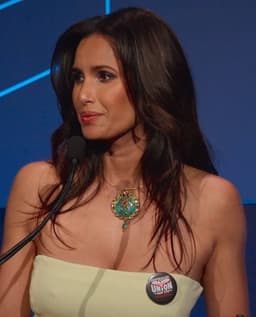

Padma Lakshmi shared this about their own health, publicly. Everything below is written in our own words, from the sources listed at the end.
Padma Lakshmi was thirty-six the first time anyone said the word endometriosis to her. She had been in pain since her first period at thirteen. That is twenty-three years of losing about a week out of every month.
In an interview published in 2015 she described what those weeks were like: doubled over, or running to be sick, unable to walk down the street. She worked as a model, and she learned to book out the week her period was due, because the few times she worked through it were not worth it. She got by on hot tea, heating pads and hot water bottles, kept her prescriptions filled, tried acupuncture, tried anything. She knew when it was coming and battened down the hatches.
What she did not have was a name for it. Her mother is a nurse and her father worked in the pharmaceutical industry, and health was talked about openly at home — but her mother had had the same pain, and had been prepared by her own mother to accept it, and so passed the same understanding on. Some women get cramps and some do not. Once you are told there is nothing to be done, she said, you become resigned to it.
She had good insurance. She went to her check-ups. She was examined regularly by gynaecologists in several different cities over many years. They offered her painkillers, or asked whether she wanted to go on the pill. Nobody ever suggested going in and looking, or taking a biopsy, or finding out whether there was tissue there that needed removing. She was on the pill through most of her twenties and came off it at thirty, and the pain came back hard enough to put her in an emergency room. A doctor found ovarian cysts and operated to take them out. He still did not say the word.
She was also clear about the cost that is not pain. Endometriosis arrives with puberty, she said, so it shapes how a girl comes to see her own body. While everyone talks about blossoming into a woman, what she felt were explosions in her abdomen. And it is isolating — not because she was ashamed in front of her mother, but because nobody wants to ring a teacher or a boss and say they cannot come in because of their period. So you say nothing, and the absences stack up unexplained.
It was only after she recovered from surgery that the size of it landed. For the first time since she was thirteen she found out what an ordinary month felt like, and then she got angry. One week in every month for all those years came to about a quarter of her life: second and third dates she never went on, exams and school dances and volleyball games she missed, jobs she lost, times she could not be there for her family or her friends. None of it recoverable. That anger is why she co-founded the Endometriosis Foundation of America.
The foundation's work with teenagers started from her own memory of being one — she did not want to go to a gynaecologist at that age, and said she still does not much want to now. So the first line was school nurses, and the foundation has presented to every public high school nurse in the five boroughs of New York. Then she went into classrooms herself, talking to boys and girls together, because the boys turned out to ask thoughtful questions and not to be squeamish if you get to them early enough. What she wants is for this to be as ordinary to talk about as a mammogram or a prostate check.
What she tells girls who find her is that they are not alone, that it has nothing to do with anything they did, that it is not being a sissy about pain, and that they do not have to buck up and take it. Endometriosis is something a person manages for as long as they have it. But you cannot manage a thing nobody will name.
Nothing here is medical advice, and one person's account is not a guide to anyone else's illness. The NHS says it can take a long time to diagnose endometriosis, and to see a GP if you think you might have it or if your symptoms are affecting your everyday life, work or relationships.
Join UnTouchable to save stories and come back to them. You do not need an account to read anything here.
Key moments
The pain starts
Aged 13
From her first period, about a week of every month spent doubled over or being sick. Her mother had had the same pain and had been told it was normal.
Years of appointments that went nowhere
Her twenties and early thirties
Gynaecologists in several cities examined her regularly and offered painkillers or the pill. Nobody suggested looking inside to find out what was there.
An emergency room, and still no name
After she came off the pill at 30
The pain returned hard enough to put her in hospital. A doctor found ovarian cysts and removed them without mentioning endometriosis.
Diagnosed at 36
Twenty-three years in
The first doctor to name it also operated. Afterwards she learned for the first time what an ordinary month felt like — and worked out she had lost roughly a quarter of her life.
Turning it into a foundation
Since her diagnosis
She co-founded the Endometriosis Foundation of America and took it into schools, starting with nurses and then teaching pupils directly, so the next girl does not wait as long.
What this story is about
Where this came from
Every story here is built only from what the person said publicly themselves. These are the sources we used.
Endometriosis Foundation of America · Interview · 18 November 2015
Padma Lakshmi is not affiliated with and has not endorsed UnTouchable.
Published 20 September 2026. Something wrong here? Ask us to correct or remove this story.